How to Automate the M&A Process Using AI
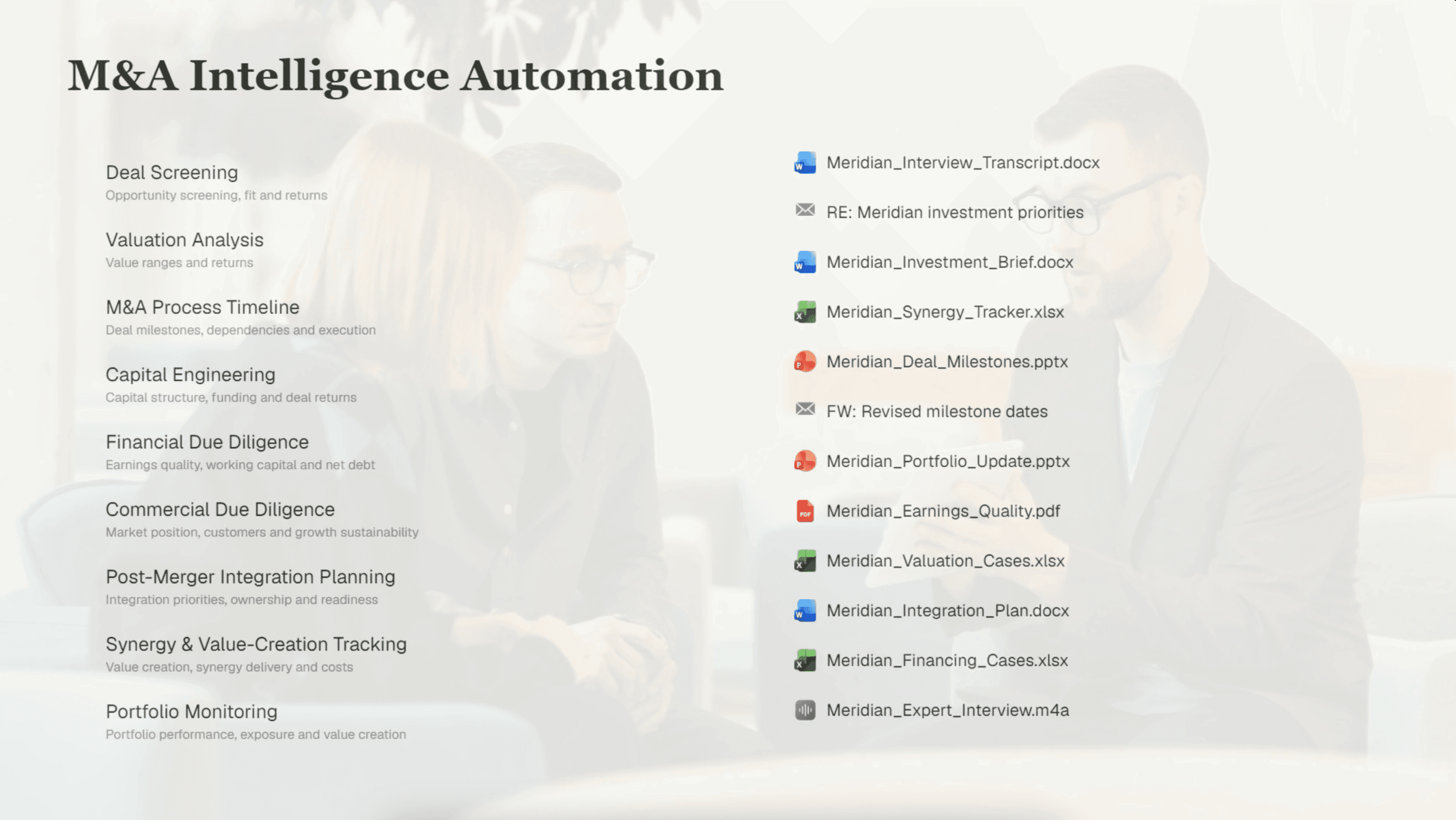
The M&A process involves dozens of analytical tasks across deal screening, valuation, due diligence, transaction planning, and post-merger integration.
Much of this work is still done manually across spreadsheets, presentations, research reports, financial statements, and data rooms.
AI can automate a large part of this workflow.
Instead of using AI for one isolated task, M&A teams can use it across the transaction lifecycle, from identifying acquisition targets to monitoring synergies after the deal closes.
What Parts of the M&A Process Can You Automate?
A typical M&A workflow can be broken into seven key stages:
Deal Screening → Valuation → Process Planning → Due Diligence → Integration → Synergy Tracking → Portfolio Monitoring
Here is how AI can support each stage.
1. Automate M&A Deal Screening
Start by automating the process of identifying potential acquisition targets.
AI can analyze company information, financial performance, industry data, and acquisition criteria to identify companies that fit a specific investment thesis.
Instead of manually reviewing hundreds of companies, teams can use AI to narrow the universe and focus their attention on the most relevant opportunities.
2. Automate M&A Valuation
Once a target has been identified, the next step is understanding what the company is worth.
AI can help analyze financial statements, build valuation models, calculate trading and transaction multiples, and test different assumptions.
Teams can also simulate changes in revenue growth, margins, multiples, and other assumptions to understand how they affect valuation.
3. Automate M&A Process Planning
An M&A transaction involves multiple teams, deadlines, workstreams, and dependencies.
AI can help organize the transaction process by creating workflows around tasks, owners, timelines, dependencies, and deliverables.
This reduces the manual coordination required to keep different workstreams moving.
4. Automate M&A Due Diligence
Due diligence is one of the most time-intensive parts of an M&A transaction.
AI can analyze financial and commercial information across large volumes of documents and data.
Financial due diligence
AI can help analyze:
- Revenue and EBITDA
- Customer concentration
- Working capital
- Debt and cash flow
- Historical financial performance
- Quality of earnings
Commercial due diligence
AI can help analyze:
- Market size and growth
- Competitive landscape
- Customer segments
- Pricing
- Market share
- Revenue growth drivers
The goal is not simply to summarize documents. AI can connect findings to the underlying data and sources, making it easier to validate the analysis.
5. Automate Post-Merger Integration
The work does not stop when the transaction closes.
Post-merger integration involves coordinating initiatives, timelines, dependencies, risks, and responsibilities across the combined organization.
AI can help turn due diligence findings and transaction objectives into structured integration plans and track progress across workstreams.
6. Automate Synergy Tracking
Expected cost and revenue synergies are often an important part of the deal thesis.
After closing, teams need to track whether those assumptions are translating into actual results.
AI can compare expected and actual performance, track synergy initiatives, and highlight areas where results are falling behind expectations.
7. Automate Portfolio Monitoring
For private equity firms and other investment organizations, the workflow continues after integration.
AI can monitor portfolio companies across revenue, margins, growth, operational metrics, and value creation initiatives.
This allows teams to identify changes in performance and investigate potential issues without manually compiling reports for every portfolio company.
How to Automate the Entire M&A Workflow
The biggest opportunity is not automating one M&A task.
It is connecting the entire workflow.
Screen the deal. Build the valuation. Plan the process. Conduct due diligence. Integrate the business. Track synergies. Monitor the portfolio.
WinningStrategy.ai's AI Analyst is built to support this end-to-end M&A workflow, including deal screening, valuation, process planning, capital engineering, financial and commercial due diligence, post-merger integration, synergy tracking, and portfolio monitoring.
Instead of moving between separate tools and manually rebuilding analysis at every stage, teams can use AI to perform more of the underlying analytical work in one workflow.
Automate the M&A process. Spend more time on the deal, and less time building the analysis.
AI Analyst that delivers the work of a consulting team, in minutes
Every number auditable, so you can defend it with confidence